| Korea's Sam-Taegeuk Symbol |
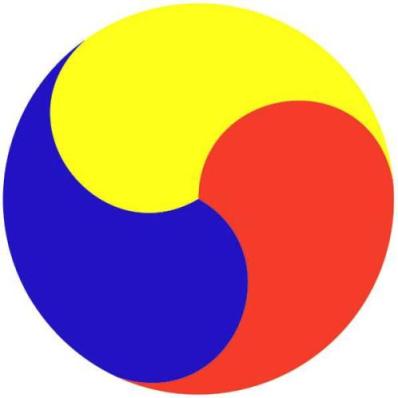
| the Korean-style Sam-Taegeuk [three-part Grand Ultimate] Symbol, used in Korean Shamanism, Neo-Confucianism, Daoism and Buddhism Blue = Heaven Red = Earth Yellow = Humanity Heaven influences Earth, which influences Humanity, which influences Heaven... or, in other interpretations, Blue = Heaven, Yellow = Earth and Red = Humanity (depending whether Red is seen as the color of Chinese farming-soil or of human blood, and Yellow is seen as the color of soil or of human skin; the Chinese Emperor wore yellow robes in representing Humanity as the "Son of Heaven".) It doesn't seem to matter which color is where. |
The Korean Sam-Taegeuk symbol above is
related to but quite different from the better-
known Chinese Yin-Yang 陰陽 yīnyáng 阴阳 symbol
(right), also called the Taijitu 太極圖 Taìjí tú 太极图 or
T'ai-chi, literally "Diagram of the Supreme
Ultimate", most frequently used in Chinese Taoist
and Neo-Confucian philosophy and cultural arts.
related to but quite different from the better-
known Chinese Yin-Yang 陰陽 yīnyáng 阴阳 symbol
(right), also called the Taijitu 太極圖 Taìjí tú 太极图 or
T'ai-chi, literally "Diagram of the Supreme
Ultimate", most frequently used in Chinese Taoist
and Neo-Confucian philosophy and cultural arts.

Stained-glass-mosaic window in the Hyehwa
Catholic Church of Seoul -- Heavenly Blue is on top.
Catholic Church of Seoul -- Heavenly Blue is on top.

On the tiled walls of the Dongnip-mun Metro Station
in NE Seoul below Inwang-san, Red is on top.
in NE Seoul below Inwang-san, Red is on top.

A very interesting variation was found on the flag of a major Shamanic Association,
photographed at their Sanshin-je Ceremony at Inwang-san in April 2009. This could
be called an "O-Taegeuk", with five colors (Yellow forming the center, which is
traditional in Five-Directions Theory), apparently derived from the classical Five
Phases (Elements) Theory of Chinese Daoism, called Ohaeng in Korean. The Five
Phases known as Metal, Wood, Water, Fire and Earth are usually represented in Five
Colors: White, Black, Blue, Red and Yellow -- but here black has been replaced by
green. An official of this group told me that this was an "ancient original Korean
Ohaeng, different from the Chinese system. I know nothing further about this claim.
photographed at their Sanshin-je Ceremony at Inwang-san in April 2009. This could
be called an "O-Taegeuk", with five colors (Yellow forming the center, which is
traditional in Five-Directions Theory), apparently derived from the classical Five
Phases (Elements) Theory of Chinese Daoism, called Ohaeng in Korean. The Five
Phases known as Metal, Wood, Water, Fire and Earth are usually represented in Five
Colors: White, Black, Blue, Red and Yellow -- but here black has been replaced by
green. An official of this group told me that this was an "ancient original Korean
Ohaeng, different from the Chinese system. I know nothing further about this claim.

Early versions of the Republic of
Korea's Taegeuk-gi National Flag
Korea's Taegeuk-gi National Flag


| Symbol and name "Sam-taegeuk" used by a nationalistic organization at a festival |

| said to be from 1882 |
| Neo-Confucian two-part Taegeuk, llight-red & blue on royal-red background, with extra-long swirls, on the gate of the Shrine to "Hoeheon" An Hyang at the Sosu-seowon Academy |
| 6-part Taegeuks on the Great East Gate of Seoul (Dongdae-mun, or Heunginji-mun) |

| 1912, Cheongsong County relic |
| Taegeukgi that hung in the office of Kim Gu, President of the ROK in exile in China, about 1940-45. Note the vertical orientation of the Taegeuk -- more Chinese-style. |
